

What is PPM?
Project Portfolio Management (PPM) is a high-level management strategy used to centralise, evaluate, and oversee a company's entire collection of active projects and programmes. Unlike standard project management—which focuses on executing a single project successfully—PPM looks at the bigger picture to ensure that all investments, budgets, and staff align directly with the organisation's long-term business goals and financial objectives. By treating projects like a financial investment portfolio, PPM helps executives and stakeholders make data-driven decisions on which projects to prioritise, fund, pause, or cancel to maximise overall business value
PPM Platform Functions
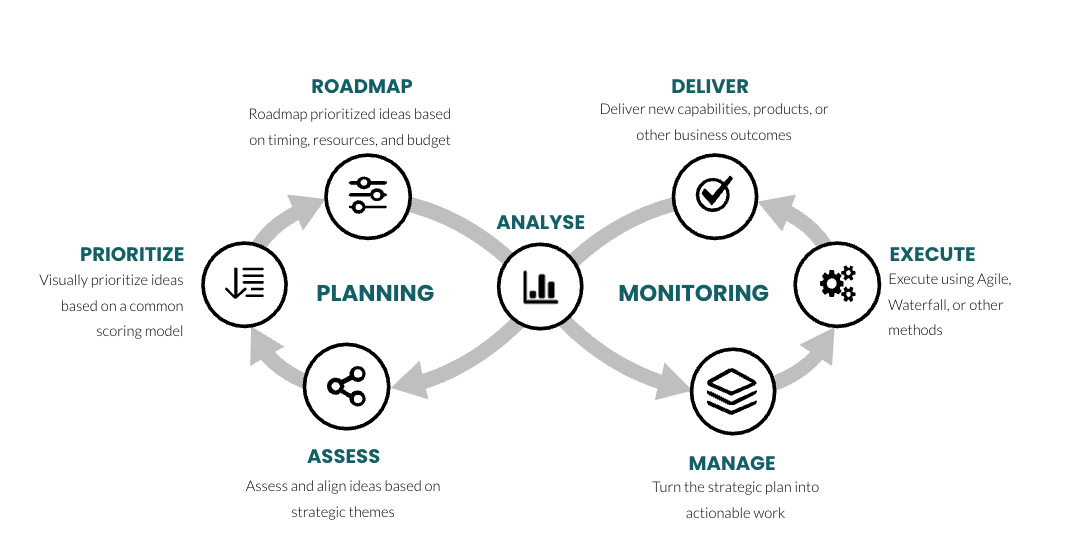
Work
Cost management
Resource management
Project / team delivery management
Adaptive Program management
Planning and Scheduling management
Task and collaboration management
Investment Capacity Planning
Financial & Cost Modelling
Business Rules Validation
Rank / Prioritise Investments
Demand Management
Scenario Analysis / What-If Modelling
Portfolio Balancing & Adjustment
Strategy (Strategic Portfolio Management SPM)
Objectives and Key results
Innovation
Imitative Planning
Business Architecture
Road mapping
Predictive & Adv. Analytics
Outcomes (Outcomes and Benefits alignment)
Strategy & Business outcomes
Value-based Investment
Agile & lean portfolio Mgt.
Business Alignment
Product Alignment
Value Delivery and ROI
Key PPM Outcomes
Strategic Alignment & OKRs: It maps business goals, investments, and Objectives and Key Results (OKRs) directly to active projects. This ensures the company only funds initiatives that drive actual business value.
Capacity & Resource Planning: Built-in interactive heatmaps and resource workbanks allow managers to see exactly who is over or under-allocated. It helps balance staff capabilities and financial constraints before taking on new work.
Financial Forecasting & Funding: The platform tracks time-phased budgets, actual costs vs. targets, and Capex/Opex spending. It supports continuous planning, allowing leadership to quickly reallocate funds when priorities shift.
Scenario Planning ("What-If" Analysis): Executives can simulate different business disruptions or strategy shifts to see how they impact budgets, staff, and project delivery dates before making real-world changes

Reduce Operating Costs by Completing More Strategic Cost Saving Projects
With Portfolio and Resource Management, organisations are provided strategic, investment and capacity planning capabilities which help identify projects with the greatest strategic impact. Organisations can create capacity for strategic work by reducing investment and time that resources (internal and contract labour) spend on lower value work. As a result, the organisation can increase the completion rates of projects that have the most strategic impact. Completion of additional strategic cost saving initiatives leads to operational cost reduction from the additional projects completed.

Increase Revenue by Completing More Strategic Revenue Growth Projects
Our mission is to provide organisations with the strategic structure and operational control required to prioritise, govern, and deliver their projecPortfolio and Resource Management solution enables organisations to maximize ROI by aligning execution with strategy. A PPM platform delivers advanced capacity planning tools that shift internal and external labour away from low-value work and toward high-impact initiatives. By optimising resource allocation, organisations successfully deliver more strategic, revenue-generating projects to drive measurable bottom-line growtht portfolios with confidence.

Reduce Time Gathering Data and Preparing Status Reports
With Portfolio and Resource Management, organisations are provided workflow automation and analytics / reporting capabilities which decreases time for manual processes including the time necessary to gather and prepare status reports and its associated costs. Forrester study indicates an average decrease of 25% in time spent on manual processes, data reconciliation, reporting, spreadsheet work with a PPM tool.

Reduce Time Forecasting/ Planning/ Allocating Resources
With Portfolio and Resource Management, organisations are provided resource management and analytics / reporting capabilities which decreases time for manual processes including the time necessary to assign and manage resources and its associated costs.

Reduce Project Cost Overruns
With Portfolio and Resource Management, organisations are provided capabilities for portfolio and project financial management, time tracking, and real-time visibility through reporting, which leads to a reduction in project overruns and their associated costs. PMI Pulse of the Profession states an average of 32% of projects are over-budget (Gartner cites 14%-56% depending on industry). Gartner studies show that budget variance is 17% on average, (9%-27% based on industry). Forrester indicates that cost overruns decrease an average of 10% using a PPM tool.

Improve Internal Resource Utilisation
With Portfolio and Resource Management, organisations are provided capacity planning and resource management capabilities to ensure the right resources are available and are working on the right projects. This leads to an increase in overall resource utilization from 1 to 5% and results in shifting capacity from business as usual (BAU) projects to deliver more high-value strategic projects. By proactively identifying gaps in resource availability, PMO leaders can work with stakeholders to adjust the start/finish dates of projects and justify additional resources.